


FAQ
Frequently Asked Questions
Below you will find the frequently asked questions by category. If your question is not listed there, feel free to contact us.
Our authentic collection
We have the world's most powerful Japanese network in the field of Japanese gardens and architecture. We work with Japanese stone masons, antique dealers, and garden centers throughout the country, but our most special partners are undoubtedly the companies that specialize in restoring ancient temples, shrines, and gardens. Thanks to all our special connections, we are able to offer the largest and most unique collection of Japanese stones and ornaments outside of Japan.
Generally, we receive between 5 and 10 full sea containers from Japan each year. Because we regularly receive new shipments, our collection remains at the highest possible level with a very diverse range of products.
Our authentic Japanese ornaments can be provided with a Certificate of Authenticity upon request. This document contains all the details about the product, such as the age, material, and origin. All this information has been confirmed by our skilled partners in Japan and forms the basis of a thorough valuation.
Shipping
We work with the best international transport partners, with whom we can easily deliver everything worldwide door-to-door. Orders are well-protected and securely packed using stretch film and strong wrapping paper. The shipments are then carefully and, if necessary, arranged in consultation, after which loading can usually be carried out within a day, so that the shipment is on its way to you as quickly as possible.
To make delivery as accessible as possible for everyone, we require our transport partners to have a pallet truck and loading dock at their disposal so that they can easily load the shipment. Our team is always available to assist you throughout the entire transport process and answer your questions.
We always strive to have shipments shipped within a week. Unfortunately, there may be times when, due to busy periods or complex orders, more time is required. We will always keep you well informed about this after you have placed your order.
Yokoso uses only recycled packaging materials. An example of this are high-quality thick mats made of recycled rubber that offer excellent protection against damage. In addition, we also reuse everything we receive from Japan in our import shipments whenever possible, such as the stretch straps and the unique sturdy Japanese pallets.
Thanks to our very careful packaging methods, damage during shipments is very rare. Should damage nevertheless occur, we always resolve it jointly, with your satisfaction always being our top priority.
Catalog order deliveries are typically delivered door-to-door; therefore, the subsequent installation in the garden is not included. Of course, this is possible, but must be scheduled with our team of specialized landscapers. For this, you can always contact us to discuss the possibilities together.
Japanese Garden Design
Yokoso is the specialist in designing and realizing authentic Japanese gardens. Our working method is deeply rooted in centuries-old Japanese garden principles, where authenticity and balance are always central. Each design is shaped with respect for these traditions, ensuring the garden not only looks Japanese, but truly feels that way. This is something that will most likely be missing with a designer who is not familiar with Japanese traditions.
In addition, we manufacture all custom woodwork in our own workshop, with an eye for detail and a high standard of craftsmanship. As the culmination of our specialization, we boast the largest collection of authentic Japanese stones and ornaments outside of Japan, allowing us to give every garden a unique and authentic character.
That is certainly possible! Yokoso has a very international focus and our team has worldwide experience. Think of projects throughout the European Union, but also in, for example, the United States, Switzerland, and the Arab world. You can contact us for more information and a tailored quote.
We always try to offer a customized package at a fair price, based on the available space and your preferences. You can contact us without any obligation to discuss the possibilities.
Our design team aims to complete a full 3D design within two to four weeks, depending on the complexity. Once the design is ready, we will jointly schedule an appointment to present the design.
Our 3D garden designs provide a complete picture of what the garden will look like, including all planting: from trees and shrubs to ground cover.
Every space is suitable for an authentic Japanese garden. When thinking of a Japanese garden, many people picture large dry rock gardens or expansive stroll gardens, but small spaces are also exceptionally well-suited for this Japanese art form. A great example is the cozy Tsuboniwa inner gardens of the Kyo-Machiya townhouses in Kyoto.
Yokoso works with a close-knit team of specialized gardeners, including craftsmen from Japan. To ensure that the design is executed down to the smallest detail and completely in accordance with Japanese tradition, we recommend that our team also handle the construction.
There are various types of Japanese gardens, each with its own character and essence, such as tea gardens, dry rock gardens, pond gardens, and bonsai gardens. Through a personal consultation and a mood board, our design team gets a clear picture of your wishes and preferences. Based on this, a design is developed that seamlessly aligns with them.
A careful design for an authentic Japanese garden is characterized by understatement and simplicity. Excess and busyness detract from the experience; balance and tranquility form the very essence. Without sufficient experience, this harmony can easily be lost.
Therefore, elements such as stone, greenery, and water are always applied in the correct proportion and coherence. We strive for a balanced whole and never choose an excessive application of one specific element, because this disrupts the natural harmony of the garden.
It is common for existing elements to be incorporated into a design. Consider, for example, a large tree that is preserved and around which the Japanese landscape is shaped. We have a lot of experience with this. Preserving such elements does not have to detract from the appearance and tranquility of the garden.
The term Zen garden refers to the gardens that can be admired at Zen Buddhist temples. These gardens are also known as dry landscape gardens, or Karesansui (枯山水) in Japanese. They are characterized by the use of gravel with carefully placed stones within it. Trees and plants often play a supporting role here.
These gardens are meant to be admired from a specific point and at a certain distance. This differs from other Japanese gardens, such as pond gardens and tea gardens, in which visitors can actually walk and discover the landscape step by step. These gardens are often equipped with stepping stone paths and a greater variety of ornaments and plantings.
Landscaping
Our landscapers are the experts when it comes to creating authentic Japanese gardens. The correct application of certain elements is a crucial process for creating a balanced landscape. For example, the placement of stones and the lines that follow centuries-old principles must be in proportion to all other elements. Only with a lot of experience and thorough knowledge of traditional Japanese gardens and overall aesthetics is it possible to create gardens like those you see in Japan.
We are also the proud owners of the largest authentic collection of Japanese stones and ornaments outside of Japan, so it goes without saying that we always make good use of this when selecting materials for a garden project. Moreover, from our own high-quality workshop, we provide all the necessary custom-made woodwork for a project. Because we handle everything ourselves as much as possible, we can offer the highest level of quality and authenticity that our customers expect from us.
Our projects almost always start with a 3D design to ensure that everything fully meets your wishes and expectations, and so that our landscapers have a clear idea of how to shape the landscape. If there is already a clear design, it may be possible for our landscapers to help you with the construction without a 3D design from Yokoso. Please feel free to contact us to discuss the possibilities together.
Despite the fact that our landscapers are based in the Netherlands, the Yokoso team is highly international with experience worldwide. Examples of projects include those throughout the European Union, but also in the United States, Switzerland, and the Arab world. You can contact us for any possible opportunities and a customized quote.
The cost of a project depends greatly on its size and complexity. In addition, the choice of materials, authentic Japanese or an alternative, always plays a significant role. Through a tailored quote, we will ensure that everything is clear so that you are not faced with unexpected surprises. Only with a clear written agreement and your consent will we carry out the construction and associated work for you.
Our gardeners are highly motivated and dedicated to creating your Japanese garden. The time required for this depends greatly on the size and complexity of a project. The overall time required for the creation of an average garden of 100 m2 is between two and four weeks.
Every space is suitable for an authentic Japanese garden. When thinking of a Japanese garden, many people picture large dry rock gardens or expansive stroll gardens, but small spaces are also exceptionally well-suited for this Japanese art form. A great example is the cozy Tsuboniwa inner gardens of the Kyo-Machiya townhouses in Kyoto.
Our gardeners are always ready for you and work throughout the year. Only in severe frost may there be delays.
It is not necessary for you to be present during the construction process, but if you prefer, you are of course welcome to do so. Our gardeners usually receive an extra key to the back door during the course of a project so that they can always get started immediately. We always discuss this in advance before a project begins.
We will completely take care of the transport of your materials and the removal of debris.
We always start with a clean slate when we are going to create a Japanese garden, and therefore we will always start by clearing the current garden. With our excavators we clear the garden so that we can quickly start the construction of the authentic Japanese landscape. Of course, existing elements such as trees can be included in the new design, so this will of course be taken into account when clearing your garden.
There are certainly forms of the Japanese garden that are advantageous to create. For example, using gravel instead of ground cover plants. But the choice of materials themselves can also make a big difference, such as choosing replica ornaments instead of authentic Japanese pieces.
Maintenance and aftercare
Aftercare is a matter of course with us! An authentic Japanese garden takes time to develop, and is truly achieved through years of proper maintenance. Therefore, after every garden we install, we always offer the option of providing specialized maintenance.
We always recommend two maintenance visits per year ourselves. A thorough check-up in the spring, the beginning of spring, and a thorough check-up in the autumn, the end of autumn. Of course, we can also come by once a year if that is preferred. We can also provide more frequent maintenance in consultation. You can decide this yourself in complete freedom.
Our goal is always to create a garden that is beautiful to admire all year round. We do this by using mainly evergreen plants.
This varies greatly from garden to garden, but generally speaking, watering during the cold winter months is less necessary. After every garden we install, we always provide customized advice regarding watering and minor maintenance.
If you don’t want to spend too much time maintaining your pond or water feature yourself, a good filtration system is the right solution for you. Our specialized team can provide you with expert advice in this area.
There are many plants that are suitable for a Japanese garden that require little maintenance. Examples include ground cover plants, azaleas, taxuses, and maples.
During the autumn, many leaves fall from the trees and plants, and of course a garden without weeds is impossible. This must be removed to maintain the aesthetic appeal of the garden. Additionally, periodic pruning is important to ensure that the plants are in optimal condition.
Examples of winter-hardy plants from the Japanese garden that require relatively little maintenance include azaleas, fatsia japonica, and ilex crenata.
Japanese woodwork
Apan's woodwork is distinguished by refined proportions, strong attention to detail, and a special connection between construction, material, and environment. At Yokoso Japanese Gardens, we combine traditional Japanese design with high-quality custom craftsmanship. The result is woodwork that is not only functional, but also forms an essential part of the Japanese atmosphere and architecture.
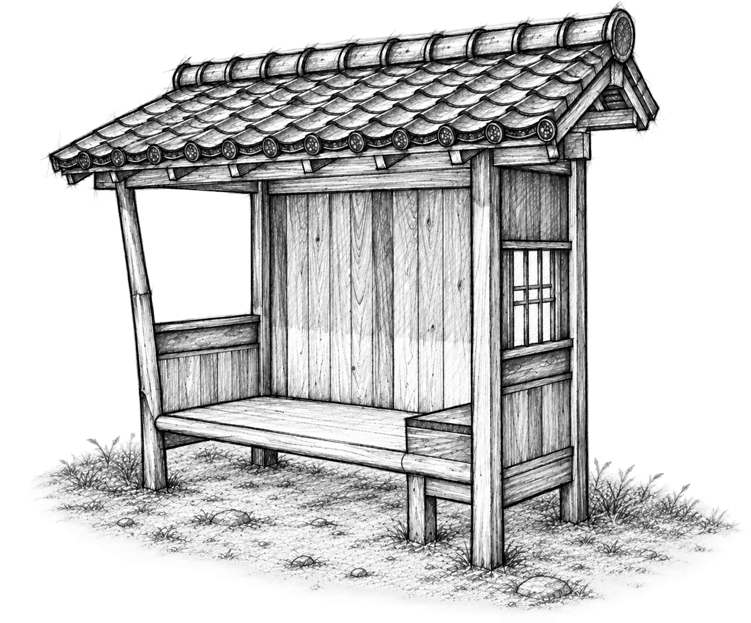
We create various forms of Japanese woodwork, including garden houses, gates, Koshikaki Machiai benches, verandas, fencing, and various architectural details. We can also develop a suitable design for special custom-made objects or wooden structures within an existing Japanese garden.
Yes. Virtually all of our Japanese woodwork is specifically designed for the location and the client's wishes. In doing so, we look at factors such as dimensions, application, architecture, sightlines, use of materials, and the relationship with the surrounding garden. This creates a design that truly becomes a part of the environment.
Yes. Where possible, we always apply traditional Japanese principles, construction methods, and wood joinery. We regularly combine these with modern architectural knowledge and techniques when necessary for durability, safety, and application within the Dutch and European climate. This way, we preserve the authentic character without compromising on practical quality.
The wood type is chosen based on the design, application, and desired appearance. We work with high-quality, sustainable wood species that are suitable for fine woodwork and exterior applications, among others. For every project, we advise which wood type is most technically and aesthetically suitable.
A large part of the specialist woodwork is prepared and manufactured in our workshop. This allows joints, dimensions, and detailing to be executed and inspected with great precision. Depending on the construction, the woodwork is partially or fully prefabricated and then assembled and finished on site.
We begin by discussing the requirements, the function of the woodwork, and the on-site situation. Next, we develop a suitable design and determine materials, detailing, and construction. Upon approval, the woodwork is crafted in our workshop. Afterward, our craftsmen handle the installation and finishing on-site. For projects where the woodwork is part of a complete Japanese garden, we coordinate both elements from the start to achieve the most exceptional result.
Normally everything is custom made and prepared in our workshop, which greatly reduces the required time on location. But the actual lead time depends on the scope, complexity, and detailing of the project. A relatively compact construction naturally requires less time than, for example, a completely custom-made Japanese gazebo or teahouse. After the design, we can provide a realistic schedule for both production and assembly.
Because every project is different, we do not work with a single fixed price for Japanese woodwork. The costs are determined by factors such as dimensions, wood type, construction, detailing, finishing, and assembly. Based on your wishes, we can put together a design and a suitable quotation.
Yes. For exterior woodwork, we take the Dutch climate into account from the design stage onwards. Material selection, detailing, ventilation, water drainage, and wood protection play an important role in this. Traditional Japanese design principles are adapted to local weather conditions where necessary, ensuring the woodwork remains visually appealing and structurally reliable for the long term.
The required maintenance depends on the type of wood used and the chosen finish. Some wood species can weather naturally, while others can be treated periodically with a suitable oil or protective finish. In addition, we recommend inspecting the woodwork regularly and keeping it free from prolonged moisture, dirt, and organic material. Upon delivery, we can advise on the maintenance that specifically suits your project.
Certainly. This is precisely one of the strengths of Yokoso Japanese Gardens. We can integrate the woodwork into a complete Japanese garden starting from the design phase. As a result, architecture, planting, stones, water features, paths, and wooden structures can be designed as one cohesive whole. This ensures a much more natural and authentic end result than if these components were developed separately.
 Nederlands
 English
 Deutsch (Sie)
 Français
 Español
 Polski
 Čeština
 Italiano